
Milpitas City Directory Holdings
Milpitas is in Santa Clara County, so its historical city directory trail follows the county's San Jose-centered publishing pattern. History San José reports San José and selected county directories from 1870-1979, and the California Room holds the same series. A reverse street-address index begins in 1914. Milpitas inclusion varies by edition, so check each volume's coverage statement.
| Collection | Years | Where Held | Access |
|---|---|---|---|
| San José and selected county directory volumes | 1870-1979 | History San José; California Room | In person; reverse address index from 1914 |
| Santa Clara County yellow and white pages | 1905-2018 | History San José | Ask for the specific issue in person |
| 1920 Polk-Husted volume XIII | 1920 | San José Public Library Digital Collections | 601 image volume online |
| San Jose white pages with Milpitas | February 1971 | Library of Congress | Digitized page images |
| Milpitas Post | 1955+ microfilm; 1955-2016 digital | Milpitas Library | Microfilm and digital access in library |
| County newspaper Digital Reel | 1895-2018 overall; 1895-1923 remote | Santa Clara County Library District | Full run in library; narrower home range |
| Yearbooks, local histories, and vertical files | Dates vary | Milpitas Library | Reference desk and in-house files |
History San José and the California Room are the strongest stops for city directory volumes and reverse work. Milpitas Library adds newspapers, yearbooks, maps, guides, and directories. SCCLD supplies genealogy databases and Digital Reel newspapers, with the broadest run inside a library. Remote results start a trail but do not replace the volume or page image.
The Santa Clara County Library District genealogy resources page is a useful starting point for the county's digital newspaper and family-history tools.
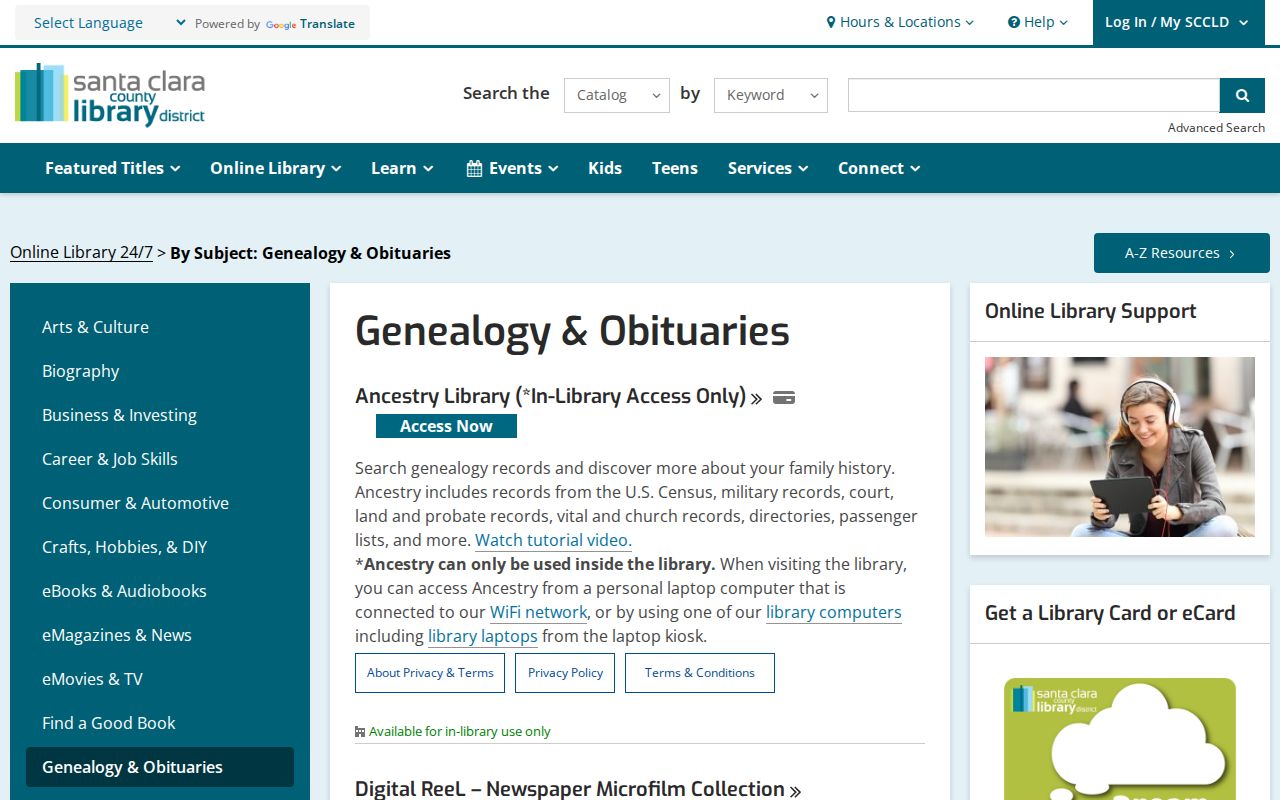
Full Digital Reel access is in the library; the narrower remote range does not promise every Milpitas title. Ask the reference desk which format holds the needed year.
Why Milpitas City Directories Vary by Edition
Milpitas incorporated in 1954, but earlier residents were recorded within county, township, ranch, and San Jose suburban contexts. That jurisdiction history explains why a directory may describe a broad county area while giving only a few Milpitas entries. A printed locality label is a publishing choice, not proof that the book surveyed every household inside today's city limits.
Publishers also changed their coverage and arrangement. One volume may use a city list, another may add selected county communities, and a telephone book may list subscribers rather than every resident. The research file does not establish an exact Milpitas-only Polk run or a final printed year, so completeness should never be inferred from a single catalog result. Compare the title page, coverage note, locality headings, and page sequence for each edition.
Edition check. Read the coverage statement before copying a Milpitas entry, because county-wide directory runs include the city unevenly from volume to volume.
Reading Milpitas Directory Entries
A directory entry is a compact set of clues. February 1971 San Jose white pages can show a surname, given name or initials, household notation, street address, telephone number, and the locality form Milpts. Business entries add a name or type and address. Polk-Husted volumes may add a trade, spouse or widow notation, and residence marker. Each mark belongs to that edition's key.
The digitized 1920 Polk-Husted Directory of San Jose City and Santa Clara County, volume XIII is an especially useful sample. Its 601 images include an alphabetical list of firms, professionals, and private citizens, plus a street guide, rural free-delivery routes, a householder guide, a classified directory, and abbreviations.
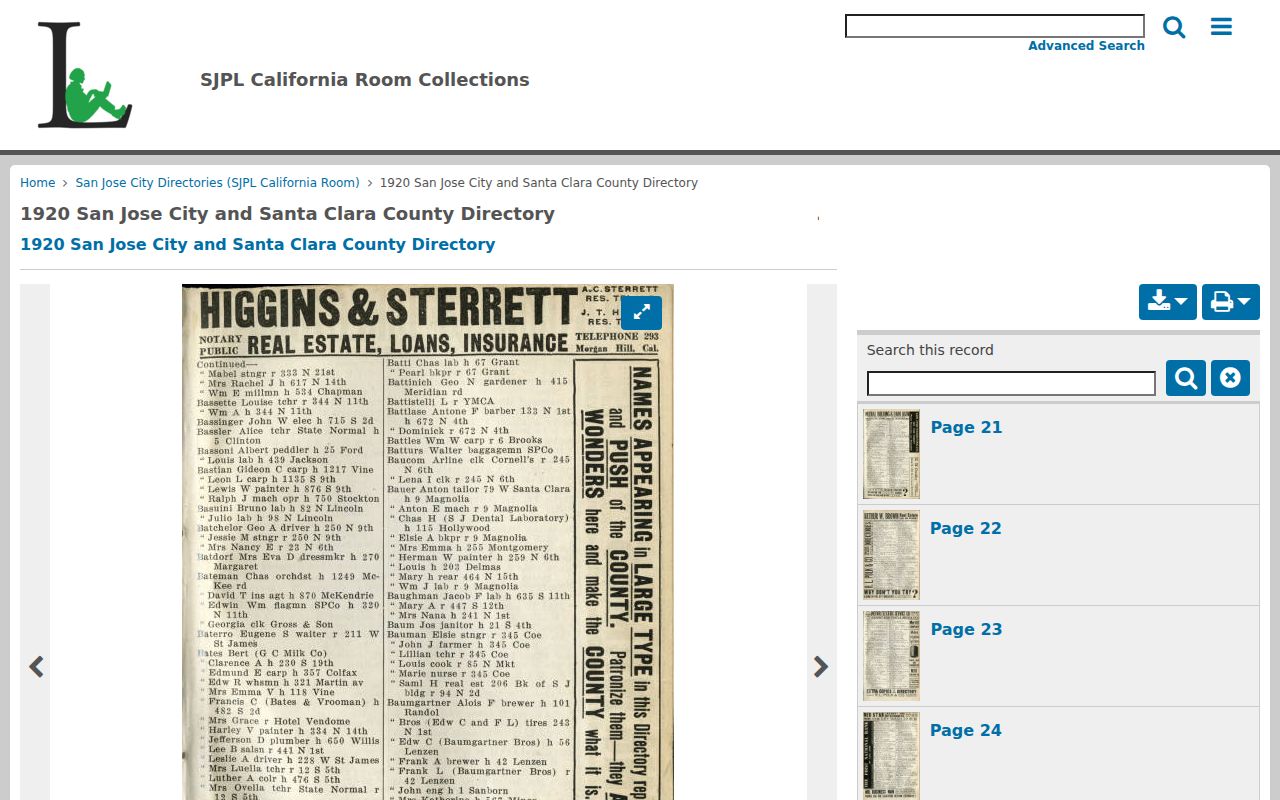
Photograph the abbreviation key first. Examples include h for home, r for resides or rooms, and carp, lab, tchr, bkpr, stngr, mach opr, and whsmn. A line may also use Mrs, widow forms, or quotation marks continuing a surname.
| Name line | Surname, given name or initials, and household or spouse notation when shown. |
|---|---|
| Trade or role | Older abbreviations for an occupation, followed in some editions by a business connection. |
| Address line | House number and street, often paired with h or r; 1971 pages may use Milpts. |
| Household mark | Mrs, widow wording, spouse notation, or a continued-surname quotation mark. |
| Reverse line | Street name, house number, and the listed occupant or business in address order. |
- Criss-cross directory
- An address-ordered section that moves from street name to house number and then to the listed person or business.
- Householder guide
- An index or guide organized around household heads, useful when a surname appears in more than one form.
- Abbreviation key
- The volume's explanation of short forms. Read it before expanding a mark in a family-history note.
- Reverse street index
- A street-and-number finding aid that turns an address into a published name clue rather than a complete population list.
Milpitas Directory Reverse Index
History San José's reverse street-address index begins in 1914. Instead of starting with a surname, locate the street alphabetically, move to the house number, and copy the occupant or business printed beside it. This is valuable when a family story supplies an address but not a full name. It also lets a researcher compare a sequence of nearby numbers without pretending that the sequence is a modern resident roll.
Use the reverse section as a dated clue. Check whether a street name, number, or locality changed between editions, then compare the listing with a deed date, a newspaper item, or a later directory. A subscriber may not have owned the parcel, and an owner may not have been the person listed at the telephone number. Current parcel-by-parcel work belongs in a Milpitas street directory search by address, while the historical volume answers what was printed for that year.
Note: A reverse index can reveal a published occupant at one address and one date, but it cannot prove continuous residence.
Milpitas Post and Local History Shelf
The local newspaper trail becomes especially useful after incorporation. Milpitas Library holds Milpitas Post microfilm from 1955 forward, digitized issues from 1955-2016 for in-library use, current print issues, yearbooks, local-history books, city planning and budget documents, and an Adult Workroom collection of vertical files. The files include Milpitas History and the in-house category “Maps, Guides, & Directories.” Moves, family notices, community events, and business changes can explain why a name changes between published editions.
The Milpitas Library local-history page identifies the branch at 160 N. Main Street and its historical role. The library began in a classroom in 1958 and the current 60,000-square-foot facility opened in 2009. That institutional history is also a research clue: a librarian can point to material that is not exposed as a public online directory, while vertical files remain in-house.
The library's local layer should be paired with the county-wide SCCLD Digital Reel, not substituted for it. Newspaper indexes can expose a family event or address context, but a newspaper notice is still an index clue that should be checked against the record custodian when identity matters.
A Milpitas Directory Timeline
Milpitas records make more sense when the directory shelf is placed beside the city's jurisdiction and library history. These dated points do not promise a continuous run. They show when a different search strategy becomes sensible.
| 1850 | Santa Clara County is formed, so early records may use county or township descriptions. |
|---|---|
| 1870 | History San José's documented directory run begins for San José and selected county areas. |
| 1914 | A reverse street-address index is added to the local collection. |
| 1920 | Polk-Husted volume XIII offers a 601-image county-area sample with street and householder guides. |
| 1954 | Milpitas incorporates, creating a useful boundary between earlier county context and city-era records. |
| 1955 | Milpitas Post microfilm begins, close to the incorporation era. |
| 1971 | The Library of Congress telephone directory includes Milpitas, printed as Milpts. |
| 1979 | The documented History San José directory run reaches its stated end. |
| 2009 | The current Milpitas Library facility opens, preserving a larger local-history service. |
Trace a Milpitas Household Across Directory Years
A household trail works best when each entry is copied exactly before it is interpreted. Begin with a known name or address, select the closest available volume, and keep the edition, page, abbreviation, and locality wording with the note. Then use the following sequence:
- Find the earliest plausible name-first entry and record the complete line, including spouse, initials, trade mark, address, and locality.
- Move forward through nearby directory years and mark every address change, name variation, widow notation, or gap.
- Flip to the reverse section from 1914 forward to test the street and house number, then compare nearby listings for household context.
- Pair directory years with the public 1940 and 1950 census schedules. The 72-year rule makes 1950 the newest public decennial census in 2026.
- Use Milpitas Post notices, yearbooks, clippings, and obituary or cemetery clues to explain a transition, then confirm ownership separately through deeds.
A person can disappear because the number was unpublished, the canvass missed the household, a surname changed, the edition narrowed its county coverage, or the family moved. A directory gap is therefore a prompt to test another source, not a verdict about a life. Preserve uncertainty in the research note and distinguish a printed occupant from a parcel owner.
Milpitas Directory Companion Collections
History San José's research holdings extend beyond city directories. The collection reports Jack Douglas files, abstracts of title, family-history files, biographical and subject clippings, Sanborn maps, yearbooks, microfilmed newspapers, Santa Clara County court records from the 1850s into the 1930s, and sheriff mug books from 1874-1941. Access and the present holder should be confirmed before travel. These materials can add a date, family connection, or property context without turning a historical source into a profile of a living person.
The California Room's advanced search fields are Subject, Title, Author, Location, Source, and Note. Results can be browsed from the first character and sorted by Title, Author, Location, Call Number, or Source. Search both “Milpitas” and older ranch, family, or street terms because catalog records may use Santa Clara County or San Jose instead of the incorporated city.
The History San José research library description is the best place to confirm current holdings and access conditions. The California State Archives is a separate fallback when its catalog identifies a relevant county, court, probate, naturalization, military, or government series.
When a Milpitas City Directory Listing Vanishes
A missing name in a Milpitas city directory does not prove that the person left the city or died. A printed directory may omit an unlisted telephone number, miss a canvass, use a different spelling, cover only selected county communities, or place a household under another name. The February 1971 telephone book is a subscriber source, while a Polk-Husted city directory can use different household and trade conventions.
Test the gap with the Milpitas Post, county newspapers, yearbooks, the next directory edition, the reverse street section, and public census schedules. Deeds can show an ownership transfer, but they do not establish who occupied a parcel. A family-history conclusion should name the source, date, and role shown rather than collapse owner, subscriber, household member, and occupant into one person.
Myth check. One absent listing is not proof of absence. Treat it as a coverage or spelling question until another dated source supports the conclusion.
Finish the Milpitas Directory Search
Before citing a city directory, confirm its volume, publisher, locality statement, page image, and abbreviation key. Ask Milpitas Library about local files, History San José or the California Room about the 1870-1979 series, and SCCLD about in-library newspapers and genealogy tools. The Library of Congress supplies a 1971 comparison; the 1920 digital volume shows format but does not prove every page covers Milpitas.
Keep a narrow note: name or address, volume and year, page, exact wording, and coverage basis. If Milpitas is not stated, say so.
Note: Individual Milpitas volume coverage, older street labels, and access rules should be checked with the holding library before a research trip.